
Short answer
Portable and cart-based veterinary ultrasound machines can both support high-quality work, but they optimize different constraints. Portable systems favor transport, flexible room use and field service. Cart-based systems favor a larger screen, a broader control surface, probe access and high-volume ergonomics. Neither format is automatically more diagnostic. The right choice depends on the examinations, species, operator, location, integration needs and service plan. A clinic should compare complete configurations under the same scanning task before buying.
Editorial note: This independent procurement guide was prepared from Mevidon's supplied product materials and the primary professional or government sources listed below. It contains no paid rankings and does not replace clinical, engineering or regulatory advice.
Quick comparison
| Factor | Portable laptop / handheld | Cart-based system |
|---|---|---|
| Mobility | Designed for transport or shared rooms | Designed for a stable imaging location |
| Operator interface | Compact controls or touch interface | Larger display and control surface |
| Probe workflow | One or more ports; model dependent | Often more active ports; model dependent |
| Power | Battery plus mains on many models | Primarily mains power, UPS optional |
| Best evaluation | Carry, battery and real exam test | Ergonomics, throughput and real exam test |
What is the core difference?
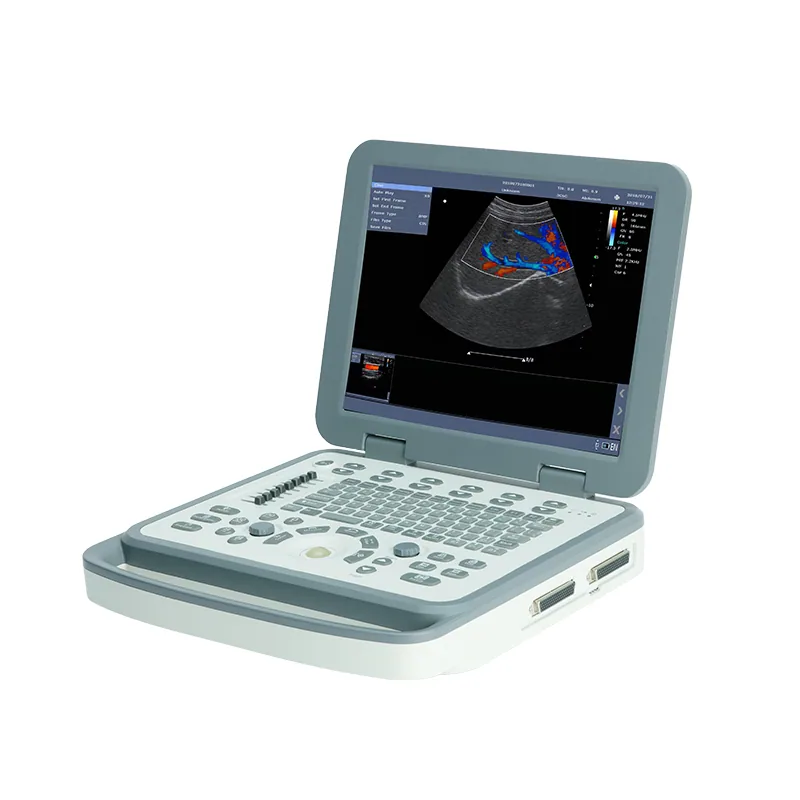
The core difference is operational design, not a guaranteed level of image quality. Portable ultrasound condenses the display, controls and power system for movement between rooms or sites. Cart-based ultrasound prioritizes an imaging station with a large monitor, accessible controls, probe holders and peripheral connections. Some laptop systems approach cart performance, while some carts are configured for routine work; model, probe and software matter more than the label.
Define the actual travel path: across one clinic, between branches, into vehicles, through barns or onto aircraft. Weight alone is insufficient. Include trolley dimensions, stairs, protective case, battery runtime, charger availability and setup time.
When does a portable ultrasound make sense?
Portable veterinary ultrasound is a strong candidate for mobile practice, farm calls, emergency rooms, operating theaters, shared treatment areas and clinics that cannot dedicate floor space. It can also provide a lower-complexity entry point when the required probes and modes are available. Battery operation is valuable where power access is uncertain, but buyers should verify runtime with the intended screen brightness, probes and workload.
Portable does not mean accessory-free. A stable trolley, external monitor, printer, protective case, spare battery or additional probe may still be needed. Price and transport decisions should use the working package, not the base unit.
When does a cart-based system make sense?
A cart-based system suits a fixed imaging room, high daily case volume, teaching environment or advanced service that benefits from a large display, full control panel, multiple connected probes and easy peripheral mounting. Ergonomics may reduce repetitive setup and cable handling during long sessions. The system may also support broader application packages, although this must be verified by model.
Plan the room before delivery. Confirm doorway clearance, lift capacity, parking position, electrical outlets, network connection, lighting, cleaning zones and safe cable routing. If the cart moves frequently, inspect wheel locks, handles, center of gravity and screen protection.
How do screen, controls and ergonomics affect productivity?
Small interfaces can be fast for focused checks but tiring for detailed measurements, annotation and reporting. Large displays and dedicated keys can help experienced users make frequent adjustments without opening menus. The only reliable test is to let the intended operator complete a typical study, save measurements and produce the required report. Count time, clicks and interruptions.
Consider posture, glove use, ambient light, left- or right-handed operation and whether a second viewer needs to see the screen. These factors can matter more to daily throughput than a modest difference in technical specifications.
Are probe options different?
They can be. Portable consoles may support a broad probe family, a limited number of active ports or adapters. Handheld systems are often built around one probe or a dual-head design. Cart systems frequently offer more ports and specialized probes, but this is not universal. Compare exact probe model numbers, frequency ranges, footprints, compatible modes and replacement terms.
If the clinic needs abdominal, cardiac and superficial imaging, request a demonstration of each intended probe. Do not assume a connector means every software package or measurement set is enabled.
How should image performance be compared?
Use a task-based acceptance sheet. Scan comparable patient sizes and anatomy with appropriate probes, then assess penetration, detail, contrast, uniformity, Doppler response and artifact handling. Keep operator and task as consistent as practical. Review both live scanning and exported images because compression, display and transfer settings may alter what downstream users see.
Ultrasound is non-ionizing, according to the FDA, but equipment should still support prudent use. Training, presets and documentation help operators obtain the needed information without unnecessary output or scan time.
Which option has the lower total cost?
The lower purchase price is not always the lower ownership cost. Add probes, batteries, trolley, cases, software licenses, DICOM, printer, training, shipping, maintenance and expected accessory replacement. For a mobile system, include transport risk and spare power. For a cart, include room preparation, UPS, network work and downtime logistics.
Ask suppliers to quote identical requirements and label exclusions. A hybrid plan may be best: one cart system for advanced or high-volume work and a portable unit for urgent, field or overflow examinations.
Copy this buyer checklist
- Where will the machine travel during a normal week?
- Which exams must be completed without changing systems?
- How many probes need to remain connected?
- Is battery operation essential, and under what workload?
- Will the operator create full reports or only focused records?
- What room, trolley, case and network accessories are needed?
- How will downtime and replacement-probe support be handled?
Buyer FAQs
Is cart-based ultrasound always better than portable ultrasound?
No. Cart systems often offer ergonomic and expansion advantages, but diagnostic usefulness depends on the specific model, probes, settings, operator and exam. Portable systems may be better for mobile or shared-room workflows.
Can a portable ultrasound perform Doppler exams?
Many portable models offer color, power and spectral Doppler, but availability and performance are model- and probe-dependent. Verify the exact modes in the quotation and demonstration.
Should a clinic buy both formats?
A two-system plan can make sense when advanced imaging stays in one room while emergency or field work requires mobility. Case volume, redundancy needs and budget should justify the second unit.
Sources and further reading
Primary sources were accessed and checked on July 19, 2026.
- FDA: Ultrasound ImagingExplains real-time ultrasound imaging, non-ionizing energy, benefits, risks and prudent use.
- Mevidon veterinary ultrasound catalogSource-supported portable, handheld, cart-based and species-oriented configurations used in this procurement framework.
Important procurement note
This guide is educational and does not replace clinical, engineering, radiation-safety, occupational-safety, regulatory or facility advice. Product capability and compliance depend on the final model and market. Confirm the signed specification, included accessories, local requirements, installation scope and service plan before purchase.